HUL by Sanjay Bahadur
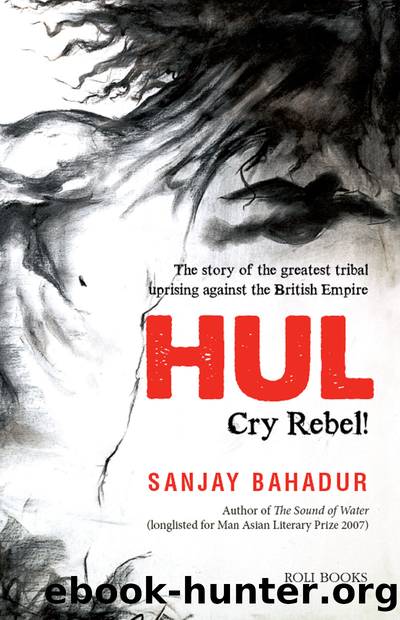
Author:Sanjay Bahadur [Bahadur, Sanjay]
Language: eng
Format: epub
ISBN: 9788186939673
Publisher: Roli Books
February 1849
The noise was overwhelming. It rose in whorls around Bikram, making him giddy. Street hawkers yelled out their rates and wares, villagers haggled and argued loudly, merry-makers laughed and chatted excitedly, women scolded their troubling kids, babies wailed, tamashbeen acrobats and entertainers whistled and whooped, beggars whined and dogs yelped. There was hardly a sound that did not sweep over the little market town of Barhait that morning.
It was the weekly market day and Santals from all the nearby villages and many from far away mountain hamlets came there to sell their produce and to buy things that they needed. Usually it was barter. The tribals came with rice, mustard or vegetables and exchanged it for salt, sugar, cloth or several of the new things â like tobacco and afim â that the diku mahajans or traders had introduced in their lives.
Very often, the traders were gumastas or clerks of local zamindars who had started small businesses of their own. They were all dikus from Bengal, Beehar or even Oudh. By virtue of being representatives of the zamindars, they had the right connections within the British administration and the muscle-power of the barkandazes or security-men of their masters. This was an essential requirement if one had to do business with the junglees â the wild tribes, as the dikus called the Santals. The jungle folk did not understand trade or commerce or currency and had strange notions about the value of their produce.
One brother may want a sack-full of salt for a bag of rice whereas the other may want a goat for the same amount of rice. It would be difficult to explain to the second brother that the value of a goat was more than that of a sack of salt. That may result in the brother complaining he was being cheated because the trader gave his other brother what he wanted â salt â but was refusing to give him what he wanted â goat. That would lead to an altercation and at times, an attempt by the disgruntled brother to walk away with the traderâs goat.
The fault was not always of the tribals. Knowing their complete lack of awareness and business sense, many traders would keep two sets of weights: the heavier one to weigh what the tribals sold and the lighter one to weigh what was paid by the trader. Sometimes, the trader would buy a perishable commodity brought by the ignorant Santal and issue a promissory note for barter payment in future, saying he didnât have ready stock of salt or tobacco for payment. The note would mention a lower quantity of the purchase from the Santal and when the poor farmer produced the chit the following week, the trader would shoo him away after paying a much reduced price.
Very few of them were smart enough to catch on to these chicaneries of the sahukars and mahajans and even if they did, the accompanying barkandazes would take care of their protests. Any market town was safe: Santals were out of their depth there and hence powerless.
Download
This site does not store any files on its server. We only index and link to content provided by other sites. Please contact the content providers to delete copyright contents if any and email us, we'll remove relevant links or contents immediately.
Sita - Warrior of Mithila (Book 2 of the Ram Chandra Series) by Amish(55253)
Crystal Cove by Lisa Kleypas(39304)
The Crystal Crypt by Dick Philip K(37040)
The Crystal Egg by Wells H.G(35691)
We Ride Upon Sticks by Quan Barry(34716)
Crowbone (The Oathsworn Series, Book 5) by Low Robert(33760)
The Secret History by Donna Tartt(19443)
Primed Son (Dark Siren Book 4) by Eden Ashley(19000)
Cat's cradle by Kurt Vonnegut(15539)
Ready Player One by Cline Ernest(15122)
Always and Forever, Lara Jean by Jenny Han(15061)
Norse Mythology by Gaiman Neil(13555)
4 3 2 1: A Novel by Paul Auster(12602)
Crooked Kingdom: Book 2 (Six of Crows) by Bardugo Leigh(12440)
The Betrayed by Igor Ljubuncic(11956)
The Betrayed by Matthew Dickerson(11727)
Scorched by Sharon Ashwood(11391)
The Betrayed: Book one of The Lost Words by Ljubuncic Igor(11320)
Scorched Treachery (Imdalind #3) by Ethington Rebecca(11244)
